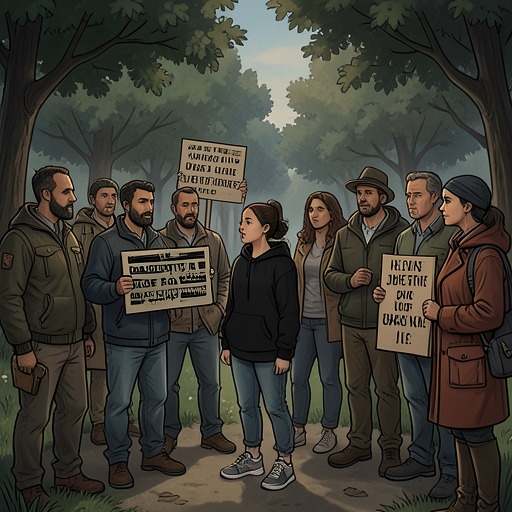
Racial harmony
I'm Still HereRacial harmony names a deceptive calm: the absence of open conflict can look like equality while leaving racial assumptions and institutional power untouched. In the book, apparently amicable classrooms, diversity-minded workplaces, and multiracial church services can all preserve the conditions they seem to overcome. The concept matters because it asks what harmony is made to protect—and who must bear the cost of keeping it undisturbed.
Schooling and the Limits of Calm
At a predominantly white Catholic high school, there were enough students of color to fill several lunch tables, form a gospel choir, and make their presence felt. The narrator recalls no major racial incidents during her four years: no swastikas in the bathrooms, race-prompted fistfights, blackface parties, or inappropriate Halloween costumes. Yet the quiet did not mean that racial bias was absent. It meant that its effects could emerge without the school’s surface calm being broken.
That contradiction became visible when Ms. Phillips, a popular religion teacher known for her energetic stories and informal life lessons, abandoned her usual seating chart. She explained that she had been separating Black students. After she failed to separate two Black girls in one class, she panicked that they would talk throughout the lesson. Her admission made the racial assumption plain: she had not treated the prospect of disruption among white students as evidence about white students as a group, but had allowed Blackness to define her expectation of the two girls.
The other students were mostly glad to choose their own seats; the narrator experienced the disclosure differently. She had admired Ms. Phillips and was suddenly unsure what the teacher had assumed about her, or whether other teachers were watching and judging her in the same way. The episode altered the meaning of the school’s friendliness. Without overt hostility, Black students could still be presumed troublesome until they demonstrated otherwise. Harmony had not made the classroom feel safe from bias; it had made that bias harder to see.
The narrator responded by claiming more agency over what she learned. She chose Black authors for book reports and Black history for history papers, rather than waiting for the standard curriculum to reflect her. When asked to repeat that Christopher Columbus had discovered America, she could instead note that the land was already inhabited; at other times she attributed the claim to the textbook. Her parents left the choice to her, including the possibility that affirming Black history might cost half a letter grade. In this setting, a calm classroom did not make the curriculum neutral: students had to decide whether to satisfy its expectations or challenge them.
When Harmony Leaves Assumptions Unchallenged
A classmate’s claim that she had been rejected by the University of Michigan because of affirmative action sharpened the same lesson. The narrator had not applied to the university, but heard the remark as an attack on Black people and felt a desire to wound the speaker in return. The teacher froze as tension rose. In retrospect, the narrator saw that four years in a racially diverse school had not unsettled her classmate’s belief that whiteness alone made her more deserving. The school’s racial harmony might not have created that belief, but its lack of confrontation had done little to undo it.
The narrator carried this experience forward as a reason to question unity that appears complete at first glance. Harmony can leave a dominant perspective intact precisely because no dramatic incident forces it into view. The work of identifying that perspective then falls to the people who experience its consequences: students who correct a textbook’s account, or who choose their own subjects to find Black lives in a curriculum that does not center them.
The Pattern Beyond School
The same gap between inclusion and changed assumptions appears in professional settings. Before joining a nonprofit organization, the narrator encountered interviewers expecting a white man; after her identity became apparent, their surprise turned the hiring conversation into an unspoken question about whether a Black woman would fit the organization’s culture. Once hired, she describes a familiar pattern: assurances that a colleague is safe to approach, stories about past institutional missteps followed by accounts of corrective gestures, and then, within weeks, comments about her hair, praise for being unexpectedly articulate, or demands that she be more Black in her speech.
When she raised incidents with the person who had promised to listen, she was told she might have misunderstood or should show more compassion. Her effort to discuss the organization’s broader hiring and leadership culture was recast as divisive or toxic. The expected complaint was about an individual bad actor, not a system that continued to reproduce itself. In this way, apparent goodwill could coexist with a refusal to act on what Black employees reported.
The contradiction also surfaced in a board discussion about a proposed racial-diversity training program. Less than a year into the job, the narrator heard the treasurer argue for Assimilation: people from diverse backgrounds, he suggested, should become one unified organization. The narrator understood that the unity he described would come at the expense of differences in thought and culture. The organization could promote diversity in its public statements while treating the existing culture as the standard to which new members should conform.
In the workplace, the costs were not limited to formal decisions. A Black employee could be mistaken for someone seeking an outreach center, have a co-worker reach for her hair, then be summoned by a supervisor because another employee felt uncomfortable. When she tried to explain, the supervisor redirected attention to her tone and advised her to be a better team player. The narrator describes these moments alongside unequal recognition and advancement: white employees praised for their gifts, while women of color are told they have potential; struggling white employees moved to better-fitting jobs, while people of color are told to improve or leave. Such routines make a promise of workplace harmony compatible with scrutiny, unequal protection, and limited influence.
Harmony, Power, and the Work of Change
The book connects these intimate and institutional patterns to a broader history that harmony can help obscure. It rejects the comforting idea that the white people who defended segregation simply disappeared or were transformed by civil-rights speeches. The same chapter points to continued avoidance of Black neighborhoods and schools, and argues that telling the nation’s history honestly requires naming White supremacy and its control over Black lives. Without that account, present-day inequalities can be treated as isolated misunderstandings instead of connected consequences.
Churches, too, may produce moving scenes of goodwill without changing their arrangements of power. Choirs from racially different congregations can sing together; a visiting pastor can preach; a church can celebrate Martin Luther King Jr. Day. These acts may create real moments of warmth, but they are not reconciliation if they leave the underlying structure untouched and ignore current injustice. Likewise, counting Black faces or meeting a diversity quota does not establish who shapes a publication, sets an agenda, or directs an organization. Representation without influence can leave the institution essentially unchanged.
The distinction extends to dialogue. Conversations about race can become a substitute for action when listening to people of color is treated as the final accomplishment, or when their anger and tone receive more attention than the harms they describe. The book’s account makes harmony a question of consequence rather than mood: goodwill matters, but it cannot stand in for changing who holds power or pursuing justice. What looks like unity is meaningful only if it does not require the less powerful to remain quiet, grateful, or unchanged.